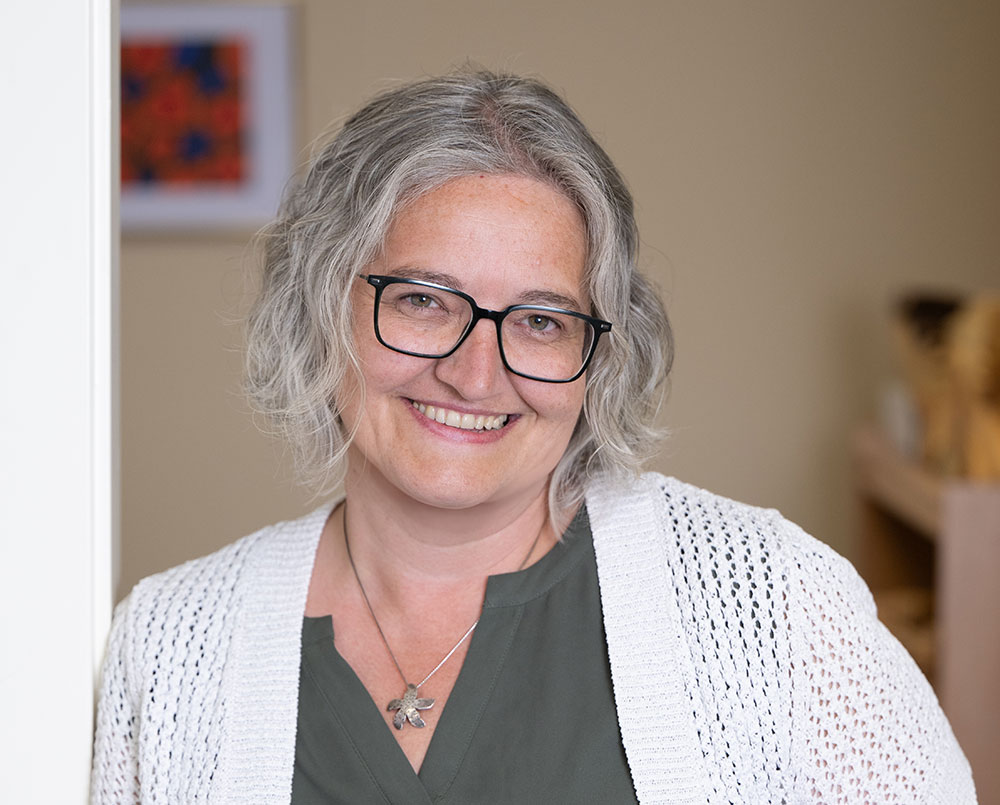
For Lynda Brosko, community leader of L’Arche Comox Valley, in BC, Truth and Reconciliation isn’t an abstract concept. It’s personal. It’s family history. It’s a story that was once left unspoken—and that she is now determined to understand.
Lynda has Indigenous roots on both sides of her family: Algonquin and Métis on her mother’s side, and Huron on her father’s. But growing up, she didn’t think of herself as Indigenous. Her family was largely silent about it.
“I was born in Winnipeg, but we moved west right away because my family was trying to break its ties to addiction and violence and all of those pieces,” she recalls. “In hearing that story growing up, I never associated it with my First Nations culture.”
Only later, as an adult, did the pieces begin to connect.
“I’m like, ‘Oh, wait a minute.’”
Lynda’s story is part of a larger one.
Growing up in northern British Columbia and the Yukon, Lynda was surrounded by First Nations communities and culture. She dogsledded, walked traplines and formed friendships with Indigenous people. Later, she spent years working with First Nations youth.
At the time, she didn’t see these experiences as connected to her own heritage. Today, she does. One story that has stayed with her is that of the Highway of Tears, where numerous Indigenous women and girls have gone missing or been murdered.
“I lived on that highway during the time that it was terrible.”
She remembers the discovery of the Pickton farm near Vancouver and the grim expectation that many of the remains would be Indigenous.
“We all waited, knowing that they were probably going to find a lot of First Nations women, just because of the number that were missing.”
Lynda attended a Red Dress Day ceremony last May, honouring those very lives.
“This isn’t distant history; these are tales that we’ve lived through. It’s a crazy part of our history.”
When culture becomes a pathway home
In a previous role, Lynda worked with First Nations youth, many of whom had experienced the foster care system. Her team incorporated culture into their work as part of healing.
Rather than simply telling young people what not to do because it was against the law, they connected those choices to something deeper.
“We were saying, ‘But that’s not what your culture says.’”
Reconnecting with their culture gave young people another reason to make different choices.
“It was really a powerful part of their healing and restoration.”
The experience also brought Lynda into closer contact with Indigenous cultures beyond her own family tradition. She began to recognize connections between the stories she was hearing through her work and those in her own family.
An unspoken private history had become part of a larger Canadian story—one shaped by displacement, disrupted family ties and lost cultural connection.
The irony of the status card
Lynda’s journey of reconnection has also exposed an uncomfortable contradiction.
The Algonquin Nation recognizes her as a member based on her heritage and lineage. Establishing that same genealogy through the Canadian government has been much more difficult. Records that could document her family history disappeared through the foster care system and other government programs.
“The government program is very colonial,” she remarks. “I haven’t been able to prove enough of my genealogy because those records are gone.”
Lynda has relatives with status cards, an uncle who is a chief, an auntie who runs First Nations programs at the University of Winnipeg. Her family connections are known within the Algonquin community. But what is recognized within the community does not necessarily translate into documentation within the colonial system.
“That’s the incongruency.”
And that’s what makes reconciliation personal for Lynda.
“My responsibility is to reconcile that part of my history so that it’s not neglected or absent. But I don’t want it showcased just for the sake of it being trendy that we’re paying attention to First Nations.”
For her, September 30—the National Day for Truth and Reconciliation—cannot be reduced to a single day, a social media post or a land acknowledgement. It asks us to listen. To remember. And to reckon with stories that have been absent, distorted or silenced.
Lynda is doing just that in her own family. Her two adult children are asking questions. She wants them to inherit something different from silence.
“We’re more mindful in our culture now.”
What does this have to do with L’Arche?
More than you might think.
The deeper Lynda dives into her heritage, the more she sees connections with the values she encounters at L’Arche: community, interdependence, listening, respect, belonging and the recognition that everyone has something to contribute.
“In First Nations communities, you work towards what’s best for the whole group,” she explains. “You see value in everyone.”
That stands in contrast to the individualism she sees in much of Western society.
“We’re told that we have to be good at everything, but when you work as a group or a community or a clan, you are just one part of the whole.”
And that, she says, is liberating.
“There’s no need for me to be good at everything, because my friends will fill in the blanks with what they’re good at.”
After three years at L’Arche, Lynda began to realize that the community felt strangely familiar.
“I’m like, ‘Yeah, I know all this stuff. This is how I’ve lived my life.’”
Lynda remembers growing up around people with disabilities who were introduced by what they could contribute—not by what they lacked.
“I remember as a kid being told, ‘That person over there, they’re really good at XYZ.’”
Only later did she realize that some of those people had disabilities.
“But that’s not how they were introduced to me. They were introduced for their gifts, not their deficits.”
Reconciliation starts close to home
In Comox Valley, Lynda and her team found a place to start almost on their doorstep: a First Nations alternative school just around the corner from L’Arche.
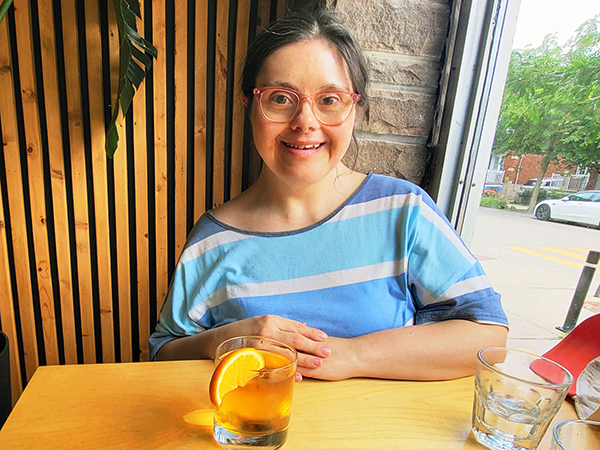
For years, the two communities existed side by side. Now, they are building a relationship. Students have volunteered with L’Arche. Julia, a L’Arche core member and strong disability advocate, has spoken with students about disability, school and belonging. For Lynda, that is reconciliation in action.
“Someone has to make the first move for people to get to know each other,” says Lynda, who showed up at the Red Dress Day ceremony wearing her L’Arche T-shirt.
She sees an important conversation waiting to happen between Indigenous communities and L’Arche.
“We know that First Nations are not represented in L’Arche, but they are probably the group in Canada most similar and relatable to L’Arche. People with disabilities were put in institutions. First Nations people were put in residential schools.”
Their shared experience of marginalization and separation from the broader community is hard to miss. And while their histories are not identical, recognizing where they intersect, suggests Lynda, can create space to learn from one another.
A different kind of future
Lynda hopes young Indigenous people entering leadership roles won’t feel forced to choose between their culture and the systems they enter.
“The world actually needs their perspective and heritage.”
She believes Indigenous ways of understanding community, conflict, responsibility and belonging can help heal Canadian society.
“Their culture and tradition don’t have to be a fight against colonialism. They can heal it just by showing up.”
Reconciliation is not about choosing one side over another.
“It’s a yes and …,” says Lynda. “We actually need both.”
You may also like...